Simon “Ash” Crowther
Ash is the atmosphere—the element that turns heavy songs into something immersive and haunting.
Atmosphere. Effects. Unease
Born in 1974 in Huddersfield, West Yorkshire, Simon “Ash” Crowther is the man behind the shifting atmosphere, live effects, and unsettling edges of Insane Overlords.
On paper, that makes him the keyboard player. In reality, it means far more than that.
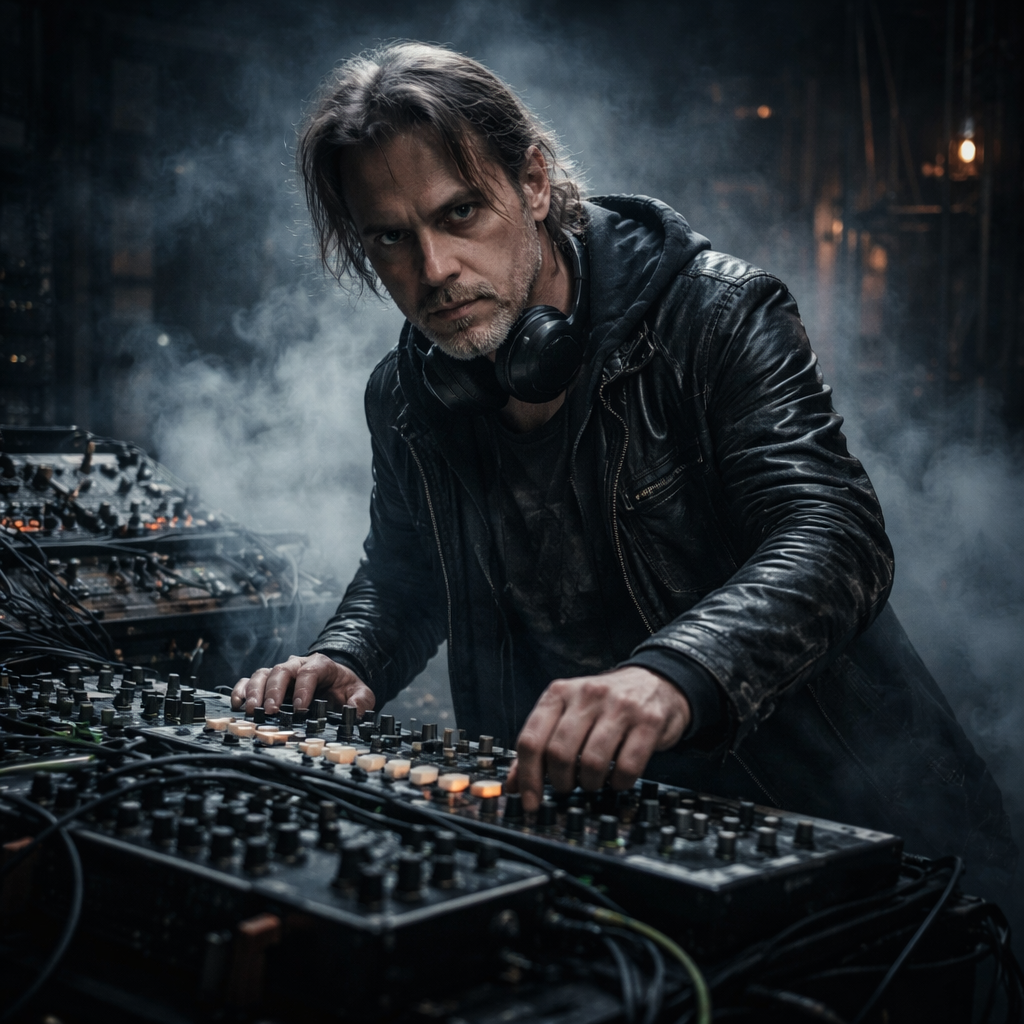
Ash does not sit at the side of a metal band politely adding a few background notes. He works in live manipulation, textures, drones, signal damage, layered effects, and the strange sonic pressure that sits around the riffs and makes the whole room feel slightly wrong. He is not there to soften the sound. He is there to haunt it.
“Ash doesn’t add keyboards to the band. He alters the air around it.”
Growing Up in Huddersfield
Growing up in Huddersfield, Simon developed early as the kind of mind that was always taking things apart to understand how they worked. Some people are drawn first to performance. Simon was drawn to systems — sound systems, circuitry, devices, interfaces, and the hidden logic behind noise.
West Yorkshire gave him the grounding. His own curiosity gave him the rest.
He grew up with music, but also with machines, signals, old electronics, and the fascination of what happened when something ordinary got pushed past its intended limits. That combination shaped the musician he would become. He was never interested only in what a note was. He was interested in what could happen to it — how it could decay, distort, smear, repeat, stretch, and turn into something stranger.
That instinct would later make him essential to Insane Overlords.
“Huddersfield gave him a place to grow. Curiosity gave him a world to disappear into.”
How He Entered Insane Overlords
Simon found his way into Insane Overlords because the band understood something important early on: atmosphere matters.
This was never going to be a standard metal setup with keyboards used as decoration or symphonic filler. Insane Overlords needed someone who could create unease, shape tension in real time, and add a shifting layer that made the songs feel less fixed, less comfortable, and more alive.
Ash brought that immediately.
What he offered was not simply “keyboards in a metal band.” It was a whole other dimension of sound — live effects manipulation, ambient corrosion, background disturbance, signal drift, and textures that could turn a track from heavy into deeply unsettling. He found a place in the band because nobody else was doing what he did, and once it was there, the songs felt wrong without it.
He did not join the Overlords to sit in the background.
He joined them to make the background move.
Metal, But With Keyboards — And More
There are still people who hear the word keyboard in a metal band and imagine the wrong thing.
That has never been the case here.
Ash is not present to make Insane Overlords sound delicate, polished, or theatrical. His role is closer to that of an atmospheric engineer than a traditional keyboard player. He works with sound beds, manipulated textures, live effects chains, transitions, noise layers, and the half-heard disturbances that sit behind the main force of the band and make everything feel heavier by making it feel less stable.
He adds depth without taking away brutality.
He adds atmosphere without losing force.
He adds strangeness without breaking the core of the songs.
In a band built on weight, Ash supplies the smoke that makes the weight feel possessed.
“This is not keyboards for decoration. This is atmosphere as a weapon.”
How He Became “Ash”
The name “Ash” came partly from history, partly from hardware.
Simon spent years working with half-burnt-out second-hand equipment, old units that crackled, overheated, hummed, failed, recovered, and occasionally produced exactly the sort of damaged sounds he wanted. There was always something singed about the setup — scorched edges, tired gear, blackened internals, equipment that looked as though it had survived a fire or caused one.
And somehow, in his hands, it worked.
“Ash” suited him because it captured both the look and the sound: burned remnants, electrical ghosts, aftermath, residue. It fit the man and the method.
Not clean.
Not pristine.
Useful precisely because it had already been through something.
“Ash came from the gear — half-burnt, second-hand, and still making the right kind of damage.”
Writing in Atmosphere and Disruption
As a writer and live manipulator, Simon works in the spaces other people often overlook.
He listens for where a song can be made stranger without being weakened. He looks for where tension can be stretched, where silence can be dirtied, where a transition can become a descent rather than a simple movement from one riff to another. He does not write to sit on top of the songs. He writes to creep through them.
That role matters enormously inside Insane Overlords.
Iron hand provides the backbone.
Rot drags the low end deeper.
Warhammer drives the force.
Hex cuts sparks and haunted melody through the mass.
Grave brings the final shape and authority out front.
Ash takes what all of them are doing and alters the environment around it. He makes the air part of the composition.
That is why no two performances ever hit exactly the same way. Simon is always listening, always adjusting, always finding new ways to make the familiar feel slightly corrupted.
“Ash writes for the parts of the room most people don’t realise are listening.”
On Stage: The Unseen Disturbance
On stage, Simon is not the member most people notice first.
That is exactly how it should be.
He works in the edges, the background, the drift behind the visible action — adding unsettling sounds, warped textures, and strange movements in the atmosphere designed not necessarily to be identified, but to be felt. His role is to make people feel odd without always being able to say why.
A low drone under a pause.
A damaged signal behind a vocal line.
A texture that creeps in at the edge of a riff and makes the whole room feel colder.
A live effect twist that changes the shape of a song without anyone noticing the exact moment it happened.
That is Ash on stage: the unseen layer, the technical hand behind the unease.
“Ash makes the room feel wrong, and that is exactly the point.”
Off Stage: Nerd, Tech Head, Computer Wizard
Off stage, Simon is exactly what many people suspect and hope he is: a nerd, a tech guy, and a full-blown computer wizard.
He is the sort of person who genuinely enjoys signal chains, interfaces, routing problems, corrupted software, impossible setups, and the quiet satisfaction of making difficult systems behave. Where some people unwind by switching off, Simon often unwinds by going deeper into the machinery.
That side of him is not separate from the music. It is the reason the music does what it does.
He understands the hidden architecture behind sound, and he brings that understanding into the band without draining any of the menace out of it. If anything, the technical obsession only makes the atmosphere darker, because he knows exactly how to build unease deliberately.
He is the rare sort of person who can speak fluent machine without losing the soul of the music.
“Off stage, Ash is the band’s resident wizard — only his spells run through cables and old processors.”
Quick Profile
Full name: Simon Crowther
Stage name: Ash
Born: 1974
From: Huddersfield, West Yorkshire
Role: Keyboard Atmosphere & Effects
Known for: Live effects manipulation, unsettling background textures, damaged sonic atmosphere
Writing style: Atmospheric, disruptive, textural, technical
On stage: Creates unease through background sound, effects, and live atmospheric shifts
Off stage: Nerd, tech specialist, computer wiz, system-builder, signal obsessive
Final Word from IOM
Every heavy band needs force.
But some bands also need the shadow moving behind the force — the thing that makes the room feel stranger, deeper, and less certain of itself.
That is Simon “Ash” Crowther.
He is the hidden layer in Insane Overlords, the man who takes sound apart and rebuilds it so it lingers in the nerves as much as the ears. He may stand slightly outside the obvious centre of the stage, but his work is woven through everything the band does.
“Ash is what happens when atmosphere stops being decoration and becomes part of the assault.”
In Conversation with Simon “Ash” Crowther
Huddersfield, damaged signals, and making the room feel wrong
There are musicians who want to be seen.
Then there are musicians like Simon “Ash” Crowther, who are more interested in changing what a room feels like from the edges.
Born in 1974 in Huddersfield, West Yorkshire, Ash is the man behind the keyboards, atmosphere, and live effects in Insane Overlords — though “keyboard player” only tells half the story. He deals in textures, disruptions, sonic damage, and the low-level psychological pressure that makes a heavy band feel heavier without anyone always being able to explain why.
IOM sat down with Ash to talk about growing up in Huddersfield, how he ended up in a metal band with keyboards and more, where the name came from, how he works with the others, and why making people feel slightly odd is often a sign the job is being done properly.
“Some players chase the spotlight. Ash prefers to tamper with the darkness around it.”
Growing Up in Huddersfield
IOM: You were born in 1974 in Huddersfield. What sort of place was it to grow up in?
Ash:
Solid place. Grounded. It leaves you with a practical side, which probably helped me later on. I was always interested in how things worked, though, so while other people were just using things, I was usually trying to open them up, poke around, and work out why they behaved the way they did.
IOM: Were you always more drawn to systems than performance?
Ash:
Pretty much, yes. Not that I didn’t love music, obviously, but I was fascinated by what sat behind it. Amps, effects, recording gear, software later on, all of that. I liked the hidden side of sound as much as the obvious part.
“I liked the hidden side of sound as much as the obvious part.”
Finding Music Through Machinery
IOM: What first pulled you towards making music?
Ash:
Curiosity, really. Sound seemed bigger once you realised it didn’t have to stay in its original form. A note could be stretched, filtered, broken, fed back into itself, turned inside out. That interested me far more than just playing something clean and leaving it there.
IOM: So it was never just about keyboards in the ordinary sense?
Ash:
No, not really. Keys are part of it, but they’re just one way in. I was always more interested in atmosphere, processing, texture, and what happened when you treated sound as something alive rather than fixed.
“A note could be stretched, filtered, broken, fed back into itself, turned inside out.”
Joining Insane Overlords
IOM: How did you end up in Insane Overlords?
Ash:
The band understood that heaviness isn’t just about riffs and volume. It’s also about atmosphere, tension, and what’s happening around the obvious impact points. That suited me. Once we started working together, it was clear there was room for what I do without it becoming decorative or pointless.
IOM: A lot of people still hear “metal band with keyboards” and imagine the wrong thing.
Ash:
Exactly. That’s why I usually end up saying “keyboards and more.” I’m not there to add some glossy layer on top. I’m there to make the sound stranger, deeper, and more unsettling. If people don’t notice exactly what I’m doing but feel different because of it, that’s usually a good sign.
IOM: So you never saw your role as softening the band?
Ash:
Quite the opposite. If I’m doing it right, the atmosphere makes everything else feel heavier by making it feel less stable.
“If people don’t notice exactly what I’m doing but feel different because of it, that’s usually a good sign.”
Becoming “Ash”
IOM: How did the name “Ash” come about?
Ash:
A lot of my early gear looked like it had survived a house fire. Half-burnt-out second-hand equipment, bits of old units, things that buzzed more than they should have, stuff with scorch marks and dodgy histories. It all had that slightly singed look to it.
IOM: And somehow you made it work.
Ash:
Mostly. Or I made it fail in ways I found useful.
IOM: Which feels very on-brand.
Ash:
Exactly. “Ash” just made sense. Burnt remnants, aftermath, residue. That was the gear and, to be fair, a bit of the sound as well.
“I made it fail in ways I found useful.”
Writing and Working With the Others
IOM: What’s your writing process like inside the band?
Ash:
I listen for space and tension. Everyone else is dealing in force in different ways, so my question is usually: where can I make this feel stranger without getting in the way? Sometimes that’s a background texture, sometimes a transition, sometimes an effect that changes the emotional temperature of a section without anybody quite noticing how it happened.
IOM: How do you work with the others specifically?
Ash:
Ironhand gives you the structural weight. Rot gives you depth and grime. Warhammer gives you drive and impact. Hex brings that eerie edge and fractured melody. Grave gives it shape and authority at the front. My role is to connect some of the hidden spaces between those things and make the whole environment feel alive.
IOM: So you’re writing for the atmosphere rather than the spotlight.
Ash:
Always. If I ever become the obvious focal point, something’s probably gone slightly wrong.
“Where can I make this feel stranger without getting in the way?”
On Stage
IOM: On stage, your work is often more felt than directly noticed. Is that how you want it?
Ash:
Yes. Ideally, people don’t spend the set watching me wondering what button I’m pressing. Ideally, they just feel that the room’s changed somehow. A bit more tension, a bit more unease, a bit more pressure in the gaps.
IOM: What are you trying to do to a room live?
Ash:
Make people feel odd, basically. Not in a gimmicky way. Just slightly unsettled. Like the songs are pushing at something behind the obvious sound. A low texture in the right place can do a lot. So can a damaged signal, a delayed fragment, a rising layer people don’t fully register until they realise they feel uneasy.
IOM: That’s a very specific ambition.
Ash:
It’s a useful one.
“Ideally, they just feel that the room’s changed somehow.”
Off Stage
IOM: Off stage, you are exactly what many people would guess — a nerd.
Ash:
Yes. Happily.
IOM: Tech guy, computer wizard, all of that?
Ash:
Also yes. I like systems. I like solving problems. I like making awkward bits of hardware and software speak to each other when they clearly don’t want to. I find that satisfying.
IOM: Does that side of you ever switch off?
Ash:
Not really. Even when I’m supposedly relaxing, I’m usually reading about something technical, testing something, fixing something, or building some unnecessarily complicated chain that I’ll probably end up using to make one strange sound for eight seconds in rehearsal.
IOM: Which is very much why you’re in this band.
Ash:
Seems likely.
“I like making awkward bits of hardware and software speak to each other when they clearly don’t want to.”
Identity, Sound, Purpose
IOM: Do you think being the least obvious part of the stage picture suits you?
Ash:
Yes. I’m more comfortable there. I like hidden influence. It’s often more effective than the obvious kind.
IOM: What matters most to you in music now?
Ash:
Mood. Depth. Purpose. And whether the sound leaves something behind in people after it’s finished. I’m not interested in surfaces on their own.
IOM: What does Insane Overlords mean to you?
Ash:
A band willing to understand that atmosphere is part of the weight, not an optional extra. That matters to me.
IOM: Last word — who is Simon “Ash” Crowther?
Ash:
A bloke from Huddersfield who likes broken gear, strange sounds, and making the room feel less comfortable than it did five minutes ago.
“A bloke from Huddersfield who likes broken gear, strange sounds, and making the room feel less comfortable than it did five minutes ago.”
Closing Note from IOM
Simon “Ash” Crowther occupies a rare place in Insane Overlords.
He is not the front-facing force of the band, nor the most visibly physical, nor the loudest personality in the room. What he is, instead, is the one who alters the room itself — the man who turns atmosphere into pressure and background detail into part of the assault.
He brings the damaged signal.
He brings the unease.
He brings the strange intelligence behind the smoke.
For a band like this, that is not extra. That is essential.