Darren “Hex” Whitaker
Born in Bradford in 1973, Darren “Hex” Whitaker is the lead guitarist of Insane Overlords — a solitary figure driven by tone, precision, and total immersion in sound.
Lead Guitar — Insane Overlords
Born in 1973 in Bradford, West Yorkshire, Darren “Hex” Whitaker is the lead guitarist of Insane Overlords and the architect of the band’s eerie, feedback-soaked edge.
If Gareth “Grave” Hargreaves is the voice at the front, Hex is the sound moving through the walls behind him — sharp, strange, and impossible to ignore.
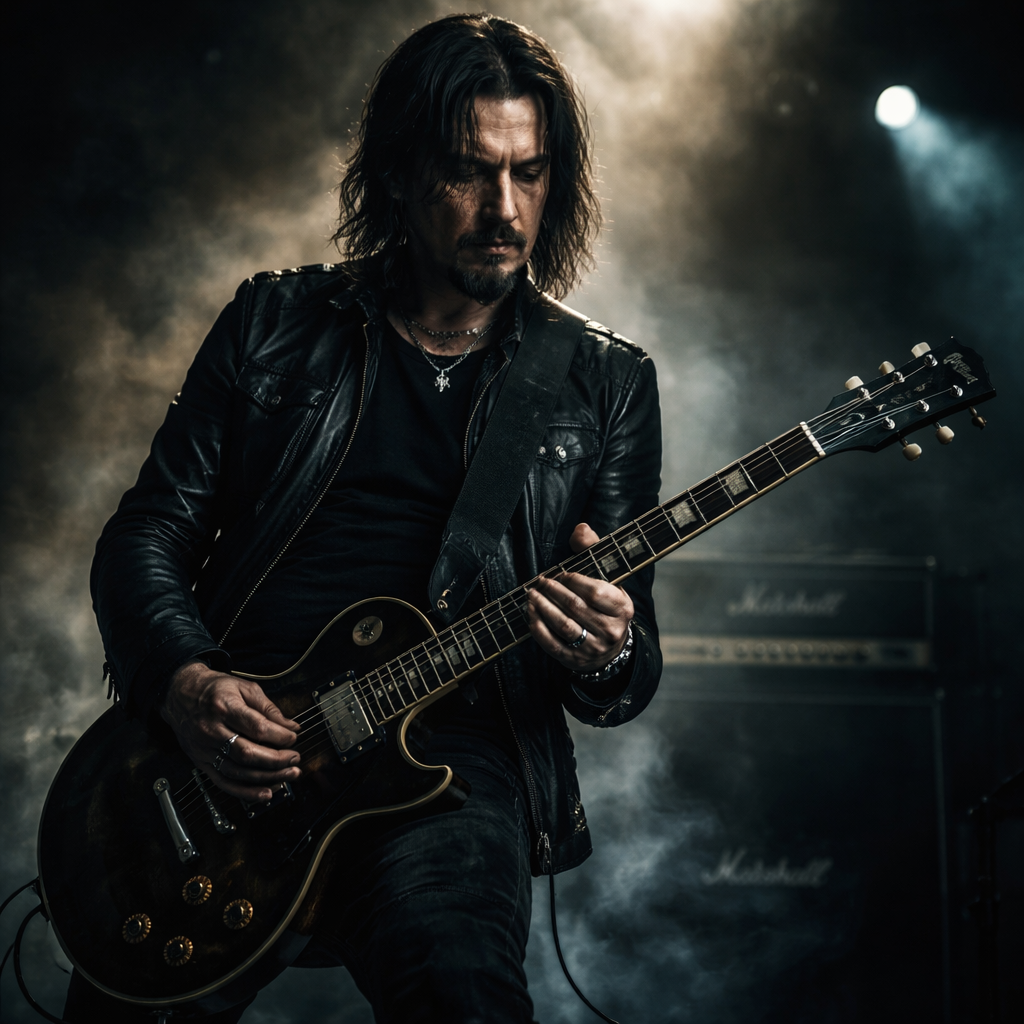
On stage, he is quiet and completely absorbed in what he does. There is no crowd-baiting, no grandstanding, no wasted gesture. His whole world narrows to guitar, sound, and tone until everything else fades into the background.
“Hex doesn’t play at the crowd. He plays through the song and somewhere beyond it.”
Bradford Born, Wired Different
Growing up in Bradford, Darren developed the kind of inward focus that never really leaves a person. West Yorkshire gives people a certain steel, but in Hex’s case it also sharpened something else — a distance, a self-containment, a sense that the real world was often less important than the one forming inside his head.
Where some musicians are drawn first to image or performance, Darren was drawn to sound itself.
Not just songs.
Not just riffs.
Sound.
Texture. Sustain. Feedback. The way a note bends under pressure. The way a cheap amp can sound wrong in exactly the right way. The way a guitar can stop being an instrument and become atmosphere.
From early on, it was clear that he was not simply learning to play. He was learning to disappear into it.
“For Hex, guitar was never just an instrument. It was the whole landscape.”
How He Entered Insane Overlords
Darren found his place in Insane Overlords because the band needed someone who understood that heaviness is not only built from force — it is built from tension, space, and the strange light that flickers around the edges of the riffs.
Where others might have approached lead guitar as a place to show off, Hex approached it differently. He brought atmosphere, abrasion, and detail. He understood how a lead line could cut through the weight like sparks off steel, and how feedback could become part of the language rather than just noise around it.
Once he was in the band, his role became obvious.
He was not there to decorate the songs.
He was there to haunt them.
How He Became “Hex”
The name “Hex” stuck because there was always something a little otherworldly in the way Darren played.
His lead work did not feel clean, tidy, or overly controlled. It moved like a signal coming through smoke — eerie, unstable, and deliberate. There was something almost cursed in the tone, something ritualistic in the way he could pull melody and damage together in the same phrase.
“Hex” fit because it sounded like the work itself.
Not a costume.
Not a performance.
Just the right name for the strange electricity he brings to the band.
“The name came from the sound — eerie, sharp, and touched by something darker.”
Writing in Fracture and Fire
As a writer and player, Darren works from sound first. Mood first. Tone first.
He is the kind of musician who can spend hours chasing the exact shape of a note, the right kind of decay, the right amount of corrosion in an amp, the precise point where melody gives way to unease. That obsession feeds directly into the identity of Insane Overlords.
Hex’s playing is not about speed for its own sake, and not about playing to a gallery. His lead work adds danger, pressure, and instability to the band’s sound. He finds the cracks in the wall and drives light through them.
When writing with the rest of the band, he brings that same focus. He listens for where a song breathes, where it threatens to come apart, where it needs a line that feels less like a solo and more like a wound opening in the middle of the track.
Everything he does serves the song — but he serves it in his own way: by deepening its atmosphere and sharpening its edge.
Working With the Others
In Insane Overlords, Darren’s work locks against the weight of Lee “Iron hand” Sutcliffe’s rhythm guitar, pushes against the dirt and pull of Mark “Rot” Ellison’s bass, and rises through the force of Tony “Warhammer” Briggs’ drums.
Against that foundation, Hex does what only he can do.
He creates movement inside the weight.
He introduces fracture inside the mass.
He gives the songs their haunted edge.
Working with Grave, Iron hand, Rot, Warhammer, and Ash, Darren remains what he has always been — a little apart, even within the band. Not disconnected, not distant in a hostile way, but separate in the way some musicians are when their inner world is tuned almost entirely to their craft.
He is part of the machine, but he lives inside a different chamber of it.
“Even in the band, Hex is slightly elsewhere — locked into tone, texture, and whatever the guitar is trying to reveal.”
On Stage: Quiet, Fixed, Unreachable
On stage, Darren says more with a bent note and a wall of feedback than most people ever manage with a microphone.
He is quiet. Focused. Completely absorbed.
There is no playing to the room, no demand for attention, no need to be seen in the usual sense. He does not perform for the crowd. In many ways, he plays for himself — or more accurately, for the sound he is trying to drag into existence.
That is what makes him compelling to watch.
He is not asking for approval.
He is following the signal.
And when Hex is fully locked in, it feels as though the rest of the stage briefly disappears around him.
“Hex plays for the sound, not the applause.”
Off Stage: The Loner with Three Priorities
Off stage, Darren remains much the same in spirit as he is on it: quiet, self-contained, and largely uninterested in distraction.
He is a single man, a loner by nature, and not someone drawn to noise for the sake of it. He is not antisocial in the dramatic sense. He simply knows what matters to him and gives very little time to what does not.
As far as the inner map goes, only three things truly matter:
Insane Overlords.
Guitars.
Yorkshire Tea.
Everything else tends to fall somewhere behind that.
There is something almost admirable in the simplicity of it. No performance, no fake mystique, no endless need to explain himself. Just a man whose world revolves around the instrument, the band, and the ritual comforts that keep the engine running.
“For Hex, the list is short: Insane Overlords, guitars, and Yorkshire Tea.”
Quick Profile
Full name: Darren Whitaker
Stage name: Hex
Born: 1973
From: Bradford, West Yorkshire
Role: Lead Guitar
Known for: Eerie lead work, feedback-soaked tone, total absorption on stage
Writing style: Sound-led, atmospheric, precise, corrosive
Off stage: Quiet, single, solitary, deeply focused
Essential priorities: Insane Overlords, guitars, Yorkshire Tea
Final Word from IOM
Every band has a player who seems less like a performer and more like a conduit.
For Insane Overlords, that is Darren “Hex” Whitaker.
He is the outsider even within the circle, the one whose entire world narrows to strings, amplifiers, and the strange life inside tone. Quiet on stage. Quiet off it. But when the guitar speaks, it says enough for him.
“Hex lives where the feedback starts to sound like language.”
In Conversation with Darren “Hex” Whitaker
Bradford, guitars, tone, and the art of staying slightly apart
There are players who treat the guitar like a tool.
Then there are players like Darren “Hex” Whitaker, who seem to live somewhere inside it.
Born in 1973 in Bradford, West Yorkshire, Hex has built his place in Insane Overlords through eerie lead work, feedback-soaked atmosphere, and an almost total devotion to sound and tone. Quiet on stage and quieter off it, he remains one of the band’s most distinctive presences — even if he seems least interested in being seen.
IOM sat down with Hex to talk about Bradford, how he entered the band, how he got his name, what writing means to him, and why the world beyond guitars rarely holds his attention for long.
“Some people chase attention. Hex chases tone.”
Growing Up in Bradford
IOM: You were born in 1973 in Bradford. What was growing up there like for you?
Hex:
Bradford was Bradford. Solid place. Real place. It gives you a certain way of looking at things. You learn not to be impressed too easily. I kept to myself a lot, to be honest. I was never one for following whatever everyone else was doing.
IOM: Were you always a bit of an outsider?
Hex:
Probably, yes. Not in some dramatic way. I just had my own head on things. I preferred getting stuck into what interested me rather than forcing myself into the usual crowd stuff. Once guitars came into it, that was that really.
“I preferred getting stuck into what interested me rather than forcing myself into the usual crowd stuff.”
Finding Guitar
IOM: What drew you to guitar in the first place?
Hex:
The sound. That’s the honest answer. Not being on stage, not being looked at, none of that. It was the sound a guitar could make when it was pushed properly. Sustain, noise, bends, feedback, all of it. It felt bigger than just playing notes.
IOM: Was it always about tone as much as playing?
Hex:
More, if anything. Anyone can learn where to put their fingers if they stick with it. Tone’s different. That takes time. It takes listening. It takes obsession, probably. I’ve never been interested in sounding tidy for the sake of it. I like a bit of damage in it.
“I’ve never been interested in sounding tidy for the sake of it.”
Joining Insane Overlords
IOM: How did you end up in Insane Overlords?
Hex:
It came together naturally. The right people, the right sound, the right intent. It wasn’t overthought. Once we started building things together, you could hear there was something in it. The songs had weight, and there was room to bring in atmosphere without softening anything.
IOM: What did you feel you could bring to the band?
Hex:
Edge, mainly. Something slightly wrong in the best sense. The riffs had strength already. What I wanted to add was the part that sits above or inside that weight — the thing that cuts through, the thing that unsettles it a bit.
“The riffs had strength already. What I wanted to add was the thing that unsettles it a bit.”
Becoming “Hex”
IOM: How did the name “Hex” come about?
Hex:
It just fitted what I was doing. There was always something eerie in the sound, something a bit off-centre. People started calling me Hex and it made enough sense not to argue with.
IOM: Did you like it straight away?
Hex:
Better than a lot of names I could’ve ended up with.
“There was always something eerie in the sound, something a bit off-centre.”
Writing and Working
IOM: What’s your writing process like when you’re working on parts?
Hex:
I listen first. I need to hear what the song is asking for. Then I’ll work at the sound until something starts to appear. Sometimes it’s a line. Sometimes it’s just a texture or a note that hangs the right way. I’m not interested in filling space for the sake of it.
IOM: So you’re not thinking in terms of showing off?
Hex:
No. Never been bothered about that. If a song needs restraint, it gets restraint. If it needs something that feels like the amp’s about to split open, then that’s what it gets. It’s about what serves the track.
IOM: How do you work with the others in the band?
Hex:
Everyone has their place. Iron hand gives the core of it. Rot thickens it up. Warhammer drives it. Ash shifts the atmosphere. Grave delivers it. I listen to where all of that is sitting and try to add the part that sharpens it without cluttering it.
“I’m not interested in filling space for the sake of it.”
On Stage
IOM: You’re very quiet on stage. Completely locked in. Is that a conscious thing?
Hex:
Not really. I’m just inside what I’m doing. Once I’m in it, the rest of the room sort of drops away. I’m listening to the guitar, the amp, the band, what’s happening in the sound. There isn’t much space left over for anything else.
IOM: Do you ever think about the crowd while you’re playing?
Hex:
No, not really. I know they’re there, obviously, but I don’t play to them. I play for the song, and probably for myself more than anything. If that connects, good. But I’m not up there trying to sell every note with a grin and a pose.
IOM: Is that why people find you compelling to watch?
Hex:
You’d have to ask them. I’m not watching me.
“Once I’m in it, the rest of the room sort of drops away.”
Off Stage
IOM: Off stage, you’ve got a reputation for being a bit of a loner.
Hex:
That’s fair enough. I like my own space. Never seen a problem with it. I’m not one for endless noise or pointless talk. I know what I care about and I stick to that.
IOM: And what do you care about?
Hex:
Insane Overlords. Guitars. Yorkshire Tea.
IOM: In that order?
Hex:
Depends how strong the tea is.
“Insane Overlords. Guitars. Yorkshire Tea.”
Staying Apart
IOM: Even within the band, there’s a sense that you remain slightly outside things. Does that feel true?
Hex:
Probably. But not in a bad way. I’m part of it completely. I just don’t live loudly. I’ve always been more comfortable letting the playing do the talking. Everyone in the band understands that.
IOM: Do you think that distance helps your playing?
Hex:
Maybe. It keeps things clear. Less clutter in your head. More room to hear what matters.
“I’ve always been more comfortable letting the playing do the talking.”
Final Questions
IOM: What matters most to you in a guitar part?
Hex:
Feel, sound, and whether it leaves a mark. That’s it. If it’s technically fine but says nothing, I’m not interested.
IOM: What does Insane Overlords mean to you?
Hex:
It means the work is real. The sound is real. The people in it mean what they do. That’s enough.
IOM: Last word — who is Darren “Hex” Whitaker?
Hex:
A bloke from Bradford who found the right noise and stuck with it.
“A bloke from Bradford who found the right noise and stuck with it.”
Closing Note from IOM
Some players demand attention.
Hex never does.
He stands in the half-light, lets the others carry the larger motion of the stage, and disappears into the one thing that matters most to him: the sound. That is exactly why his presence lands as hard as it does.
He is not there to charm a room.
He is there to open a wound in the middle of the song and let it ring.
For Insane Overlords, that makes him essential.